If you’ve just started exploring the NDIS, you may have already noticed a lot of unfamiliar terms and acronyms that can feel confusing at first. You’re not alone; many people find NDIS language overwhelming in the beginning.
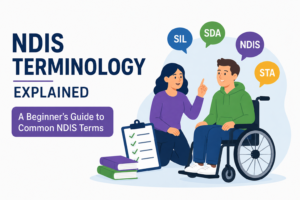
This guide breaks down key NDIS terminology into simple, everyday NDIS language, with clear NDIS definitions so you can understand them quickly and easily.
What the NDIS Is (and Who Runs It)
The National Disability Insurance Scheme (NDIS) is a federal government program that funds support for Australians under 65 with a permanent and significant disability.
It’s managed by the National Disability Insurance Agency (NDIA): the body responsible for approving participants, developing plans, and making funding decisions. When you hear people refer to “the Agency,” they usually mean the NDIA.
Common NDIS Acronyms Explained
This quick-reference NDIS glossary provides NDIS abbreviations explained for the terms you’ll encounter most often.
| Acronym | Full Term | What It Means |
| NDIS | National Disability Insurance Scheme | The federal government program that funds disability supports |
| NDIA | National Disability Insurance Agency | The government body that manages the NDIS |
| LAC | Local Area Coordinator | Helps you navigate the NDIS and connect with local services |
| SIL | Supported Independent Living | Daily support funding for people in shared or individual housing |
| SDA | Specialist Disability Accommodation | Specialised housing for people with very high support requirements |
| MTA | Medium Term Accommodation | Temporary housing during transitions (up to 90 days) |
| STA | Short Term Accommodation | A short break away from home, also known as respite care |
| SC | Support Coordinator | Assists with your plan implementation and connects with providers |
| AT | Assistive Technology | Equipment or devices that help you do things more easily or safely |
| NDIS Commission | NDIS Quality and Safeguards Commission | The independent body that registers and regulates NDIS providers |
| R&N | Reasonable and Necessary | The standard used to assess whether a support can be funded |
| ECEI | Early Childhood Early Intervention | Approach supporting children under 9 with disability or developmental delay |
The People You’ll Hear About
These are some of the most common NDIS terms and meanings you’ll encounter first.
Participant: Someone approved to access the NDIS. Before approval, you’re called an applicant.
NDIA Planner: An Agency employee who works with you to build your NDIS plan based on your goals and support needs.
Local Area Coordinator (LAC): A community partner who supports you in navigating the NDIS, understanding available services, connecting with your community, and accessing the right supports.
Early Childhood Partner: Specialists who deliver an early childhood approach that supports children under 9 with developmental delay or disability.
Support Coordinator: Helps you put your plan into action by finding and connecting with service providers, coordinating your supports, and making the most of what’s in your plan.
Specialist Support Coordinator: A higher level of support coordination for people with more complex needs or high-risk situations.
Provider: Any individual or organisation that delivers NDIS-funded supports and services. Either registered with the NDIS Commission or unregistered.
Nominee: Someone who has been appointed to act on a participant’s behalf. Either a plan nominee (for planning purposes) or a correspondence nominee (for correspondence purposes).
Carer: An unpaid family member or friend who supports a person with disability. Carers are not NDIS participants themselves (unless they have their own disability).
Understanding Your NDIS Plan Explained
Your NDIS plan is a personalised document outlining your goals, support needs, and approved funding.
Here are the key terms you’ll encounter when reading or discussing your plan.
Goals: They describe what you want to achieve in your life: become more independent, find a job, improve health, build friendships, or learn new skills. Your NDIS funding is linked to these goals and supports you in achieving them.
Reasonable and Necessary: The key test every funded support must pass. A support must relate to your disability, be effective and value for money, and not be something another system (like health or education) should provide.
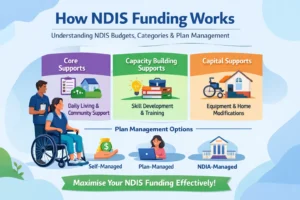
Support Categories: Your NDIS funding is divided into support categories, which are grouped into four main budgets:
- Core Supports: These cover everyday needs such as assistance with personal care, household tasks, community participation, and transport.
- Capacity Building Supports: Supports that help you build your skills and independence over time (e.g., therapy, employment support).
- Capital Supports: This budget covers assistive technology, vehicle or home modifications, including Specialist Disability Accommodation.
- Recurring Supports: A specific funding category designed to cover ongoing transport-related support needs.
Funding Periods: The timeframe within which you need to use that portion of your budget.
Service Agreement: A written contract between you and a provider outlining what will be delivered, when, how, and at what cost.
Plan Review / Plan Reassessment: When your current plan ends or your needs significantly change, you go through this process with an NDIS planner to create a new plan.
Plan Variation: A smaller update to your current plan, such as adjusting goals, changing provider details, or providing emergency funding. A plan variation is smaller in scope than a full reassessment.
How Your Funding Is Managed
One of the choices you’ll make as an NDIS participant is how your funding is managed. There are three options:
NDIA-Managed (Agency-Managed): The Agency pays your providers directly on your behalf. You must use registered providers only. This is the most straightforward option for people new to the scheme.
Plan-Managed: A plan manager (a registered NDIS provider) handles your invoices, tracks your budget, and reports to you regularly. Plan-managed participants have the flexibility to choose from both registered and unregistered providers.
Self-Managed: You manage your own funding, pay providers directly, and keep your own records. This offers the most flexibility in who you can hire and how you spend your funds, but comes with greater administrative responsibility.
Accommodation and Housing Terms
These are especially important if disability-specific housing is part of your journey. Getting a clear understanding of this NDIS vocabulary can open new opportunities
Supported Independent Living (SIL): Pays for the support workers who help you with daily tasks, whether you’re living in shared or individual accommodation. It does not pay for the accommodation itself.
Specialist Disability Accommodation (SDA): Pays for purpose-built or significantly modified housing designed for people with very high support needs or extreme functional impairment. It does not pay for the support delivered inside it.
Medium Term Accommodation (MTA): Temporary housing (usually up to 90 days) while waiting for long-term arrangements to be finalised.
Short Term Accommodation (STA): Funded respite, providing a short break away from home for both participants and their carers. An STA stay might be at a dedicated respite facility, a residential setting, or another arranged environment.
Home Modifications: Changes made to an existing home to improve safety and accessibility, such as grab rails, ramps, and widened doorways. Minor changes fall under Core Supports; structural changes fall under Capital Supports.
Assistive Technology (AT): Any device or equipment that helps you do things more safely or independently, from non-slip mats to power wheelchairs. Getting NDIS language explained here matters when talking to an occupational therapist about AT eligibility.
Why Understanding NDIS Language Matters
Understanding NDIS terminology isn’t just an administrative exercise. When you know what people mean when they talk about SIL versus SDA, or the difference between a plan review and a plan variation, you walk into every meeting better prepared.
You ask sharper questions.
You notice if something seems off.
You can advocate for yourself more confidently and make decisions that actually reflect what you need.
You’re less likely to accept a plan that doesn’t work, and more likely to know when to push back.
This NDIS terminology guide exists to make sure language never stands between you and the support you’re entitled to. Use it as your personal NDIS glossary, save it, share it with family members or carers, and return to it whenever you need a quick refresher before a planning meeting or discussion with providers.
Confused by NDIS Jargon? We’re Here for You
Navigating NDIS terminology can feel like a steep learning curve, but you do not have to figure it out alone. Understanding these terms is the first step, and having the right team by your side makes putting them into practice much easier.
At Accessible & Short Term Accommodation, we are here to support you throughout every stage of your NDIS journey. Whether you need help understanding your funding, making sense of your plan, or finding the right solutions for your needs, our team is committed to walking alongside you every step of the way.
Don’t let complex language stall your journey. Contact Accessible & Short Term Accommodation today. Let’s cut through the confusion and make the NDIS work for you.